Sheet metal bending process taboo
author: YITECH
2024-11-18
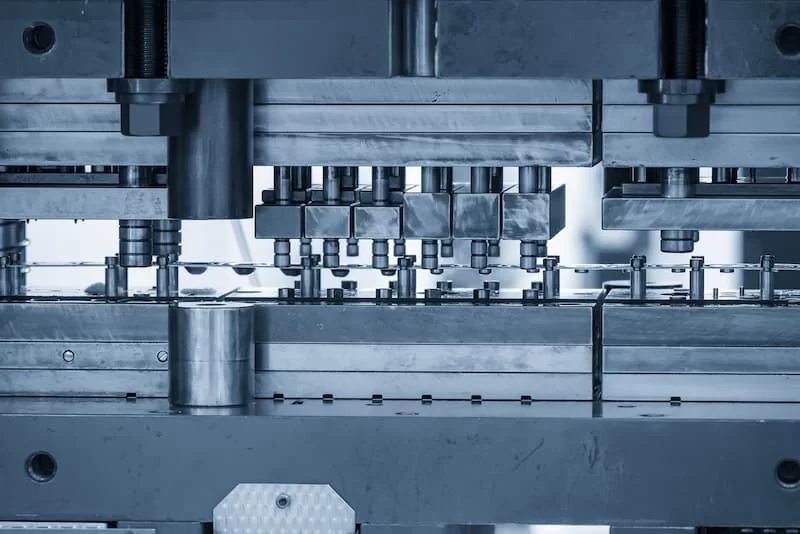
A stamping die is a precision tool used in metalworking to cut, form, and shape metal sheets into a range of complex parts and components.
In the design of stamping die, it is necessary to carry out reasonable process analysis to avoid design defects that lead to die scrapping. There are shortcomings in the design without practical operation, how to avoid process defects?

1, the bending radius should not be too large
When the workpiece is bent, in addition to plastic deformation, elastic deformation is accompanied at the same time, there is a rebound phenomenon. Therefore, the rounded corners of the bending parts should not be too large. Otherwise, the stability of the bending Angle cannot be guaranteed.
2, the bending radius should not be too small
The bending Angle R is too small, which easily causes the outer fiber to crack. For mild steel, the minimum bending fillet is about 1.0T; The minimum bending fillet of brass and aluminum is about 0.6T; For medium carbon steel, the minimum bending fillet is about 1.5T.

3, the bending straight edge should not be too small
In order to ensure the bending quality of the workpiece, the straight edge height h of the bending product should not be too small, and must be greater than or equal to the minimum bending edge height hmin. h≥hmin=r +2t
(r -- Bend round corners,t -- plate thickness of bending parts)
4, the bending edge distance from the hole should not be too small
When bending blank with holes, the hole edge spacing should not be too small. If the hole position is too close to the bending edge, the shape of the hole will change when bending. The distance from the hole edge to the curved edge L, L should conform to the following formula: When t<2, L≥r+t; When t≥2, L≥r+2t

5. The symmetry of bending shape and size should not be too different
In order to prevent deformation, the height difference of the bending parts should not be too large. The shape and size of the bending part should be as symmetrical as possible, otherwise there will be a deformed distortion at the small end. If the result is difficult to improve at design time, you must ensure that: h>r+2t
(h -- small side height; r -- curved rounded corners; t -- plate thickness of bending parts.)
6. The local curved edge should not ignore the punching unloading hole groove
When bending a section of the edge locally, in order to avoid tearing due to stress concentration at the junction, it should not be neglected to punch the unloading hole, cut the groove, or shift the bending line a certain distance.

7, narrow side bending should not ignore the process incision
When the narrow edge is bent, the cross-section shape of the deformation zone will be distorted, that is, the width of the inner surface will be widened, and the width of the outer surface will be narrowed. It is especially obvious when the plate width b<3t (t is the plate thickness).
If the width b of the bending part requires high accuracy and does not allow bulging, the process incision should not be ignored in advance on the bending line.
If the width b of the bending part requires high accuracy and does not allow bulging, the process incision should not be ignored in advance on the bending line.
8, the bending process can not ignore the rebound
Plastic deformation and elastic deformation exist simultaneously during bending. When the external load is removed, the elastic deformation disappears and rebound occurs. The rebound value is related to material properties, relative bending radius r/t, bending Angle and other factors.
The higher the yield point σs, the smaller the elastic modulus E, the smaller the r/t and the larger the bending Angle of the material, the greater the springback. In order to ensure the accuracy of the workpiece, the springback can not be ignored when bending.
The springback can be reduced by repairing the mold, using different springback directions in different parts, locally increasing triangular ribs, etc., or using the concave die structure of swinging block to reduce springback.
The higher the yield point σs, the smaller the elastic modulus E, the smaller the r/t and the larger the bending Angle of the material, the greater the springback. In order to ensure the accuracy of the workpiece, the springback can not be ignored when bending.
The springback can be reduced by repairing the mold, using different springback directions in different parts, locally increasing triangular ribs, etc., or using the concave die structure of swinging block to reduce springback.

9, the workpiece with a large bending radius can not use ordinary bending methods
For parts with large bending radius, ordinary bending methods cannot be used. Otherwise, the desired shape and size cannot be obtained due to its large elastic deformation, and the method of stretching and bending can be used at this time.
An axial pull force is added before the sheet material is bent, and the data makes the stress in the blank section slightly greater than the yield point of the material, and then bends at the same time.
An axial pull force is added before the sheet material is bent, and the data makes the stress in the blank section slightly greater than the yield point of the material, and then bends at the same time.
10, the bending of complex shape parts can not be in place at once
For curved parts with complex shapes, they can not be bent at one time, but need to be bent several times. The principle of procedure arrangement is to bend the outer corner first. The second bending cannot affect the deformation of the previous bending part. The number of bends can be two, three, or even multiple times

11. The edge of the bending part should not have gaps
If the edge part of the curved part has a gap, if the gap is rushed out in the blank, there will be a fork when bending, and it can not be formed in serious cases. It is necessary to leave a connecting belt at the gap, and then cut the connecting belt after bending and forming.
12, the structure of the bending die can not ignore the blank offset
In the bending process, the offset is an important factor affecting the accuracy of the workpiece, so before the bending begins, the blank should be partially fixed reliably on a part of the mold to prevent the offset during bending.
The holes on the parts should be used as much as possible to locate. If there are no available holes in the part, consider process hole positioning.
The holes on the parts should be used as much as possible to locate. If there are no available holes in the part, consider process hole positioning.

13, the bending mold structure should not cause the material to produce large local thinning and scratches in the closing process
The bending die should be careful to bend only at the position of the bending line determined by the part during the closing process. The blank should not produce large local thinning and scratches.
When the structure of the left figure is bent, the position of the bending line at the outer corner C changes during the bending process, first at point B and finally to point C, so that the outer corner shape of the part is not accurate and the straight arm part becomes thinner.
When the structure of the left figure is bent, the position of the bending line at the outer corner C changes during the bending process, first at point B and finally to point C, so that the outer corner shape of the part is not accurate and the straight arm part becomes thinner.
14. The mold structure shall not hinder and prevent the rotation and movement of the blank in the mold closing process
The structure of the bending die should take into account the rotation space of the blank when bending, and can not hinder and prevent the movement and rotation of the blank, otherwise it will affect the shape and size of the workpiece. This is especially important for multi-angle bending with complex shapes.

15, bending workpiece should not use a small elastic modulus of the material
The magnitude of flexural rebound is proportional to the modulus of elasticity of the material. The material with small modulus of elasticity has a large amount of elastic recovery after deformation, so it is not suitable for bending process.
For materials with the same yield point, the elastic recovery of materials with large elastic modulus after deformation is small. Annealed low carbon steel softer manganese brass is suitable for bending workpiece materials.
For materials with the same yield point, the elastic recovery of materials with large elastic modulus after deformation is small. Annealed low carbon steel softer manganese brass is suitable for bending workpiece materials.
16, bending workpiece should not be used with high yield point materials
The magnitude of the bending rebound is proportional to the yield limit of the material. Materials with high yield point have large elastic recovery after deformation and are not suitable for bending processes. That is, materials with the same modulus of elasticity and materials with high yield point have greater elastic recovery. Therefore, cold hardening steel should not be used for bending processes.

17, for bending radius and curvature Angle are very large bending parts, should not use ordinary bending methods
The bending radius and curvature Angle are very large bending parts should be rolled (rolled plate), rather than ordinary bending methods. Roll bending is to place the slab in 2 to 4 rollers, and bend the slab into shape with the rotation of the roller. In addition, because the position of the roller can be appropriately changed relative to the slab, it can also be made into quadrilateral, oval, and other non-circular section of the barrel.
18, the bending of long belt material should not be used ordinary bending methods
The bending of long strip material around the longitudinal axis should be formed by rolling rather than by ordinary bending method. Roll forming is the process of passing the strip through an array of forming rollers in straight rows.
With the rotation of the roller, the belt material is sent forward at the same time, and the axial bending is formed in sequence. Rolling forming can produce parts with complex sectional shapes. The manufacture of the shaped roller is simple, the cost is low, and the life is long
With the rotation of the roller, the belt material is sent forward at the same time, and the axial bending is formed in sequence. Rolling forming can produce parts with complex sectional shapes. The manufacture of the shaped roller is simple, the cost is low, and the life is long

19, variable section parts should not use the general rolling forming method
In order to reduce investment, rolling forming can be used for small and medium-sized batch production of variable section slot parts. At this time, in addition to the longitudinal relative movement of the forming roll to the slab, it also needs the transverse copying movement.
20, the bending of pipes and profiles should not be used ordinary bending methods
Although from the nature of deformation, the bending of pipe and profile and the bending of sheet metal are the same, but the process methods and difficulties are quite different. The bending of the pipe and profile must prevent the shape distortion of the blank section in the bending deformation area.

In the production, the bending methods of pipe and profile are tensile bending, rolling bending, pushing bending and bending. It should be noted that the working surface of the bending punch, the rolling roll, the pushing and bending fixed die should be made into grooves that match the shape of the blank section to prevent the rotation of the section and the distortion of the shape. If necessary, a corresponding mandrel should be added to the tube.
What kind of damage requires sheet metal?
Application of new technology in traditional sheet metal manufacturing
Related Article
DFM analysis for CNC milling, turning, sheet metal, and casting. Geometry check, material fit, tolerance review, and cost reduction notes — one report, all processes.
DFM Analysis: How Design for Manufacturability Cuts Cost, Reduces Defects, and Speeds Up Production

Deep drawn parts for automotive, battery casings, kitchenware, and lighting reflectors. We design the die, run the blanks, and hold wall thickness within ±0.1 mm.
Sheet Metal Deep Drawing: A Complete Guide to the Process, Materials, and Capabilities