
Nitriding for surface treatment
2024-06-18
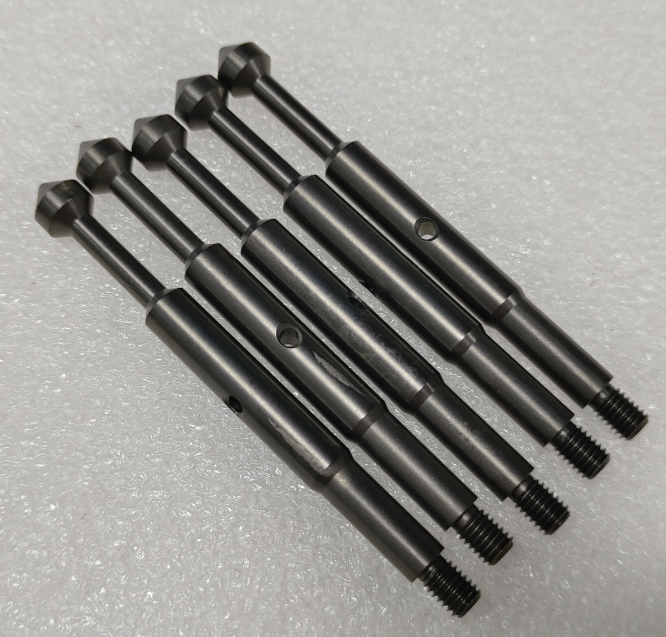
Nitriding is a chemical heat treatment process in which nitrogen atoms penetrate into the surface of the workpiece in a certain medium at a certain temperature. Liquid nitriding, gas nitriding and ion nitriding are common. Traditional gas nitriding is to put the workpiece into a sealed container, through the flow of ammonia gas and heating, after a long time, ammonia thermal decomposition produces active nitrogen atoms, constantly adsorbed to the surface of the workpiece, and diffusion into the surface of the workpiece, thereby changing the chemical composition and organization of the surface layer, to obtain excellent surface properties. If carbon is infiltrated at the same time during nitriding to promote the diffusion of nitrogen, it is called carbonitriding. Gas nitriding and plasma nitriding are commonly used.
Advantages of surface treatment nitriding:
1. Improve the surface hardness and wear resistance: after nitriding, the surface hardness can be increased by about 2-3 times, and the wear resistance is also improved accordingly.
2. Extend service life: Improving hardness and wear resistance can extend the service life of parts.
3. Improve corrosion resistance: the surface after nitriding can form a dense and hard nitride layer, which has a certain corrosion resistance.
4. Improve the surface color: the surface after nitriding presents a dark, uniform nitriding layer, and the beauty and decoration are also improved.
1. Improve the surface hardness and wear resistance: after nitriding, the surface hardness can be increased by about 2-3 times, and the wear resistance is also improved accordingly.
2. Extend service life: Improving hardness and wear resistance can extend the service life of parts.
3. Improve corrosion resistance: the surface after nitriding can form a dense and hard nitride layer, which has a certain corrosion resistance.
4. Improve the surface color: the surface after nitriding presents a dark, uniform nitriding layer, and the beauty and decoration are also improved.
Disadvantages of surface treatment nitriding:
1. High processing cost: nitriding requires special processing equipment and technology, and the cost is higher.
2. There are requirements for the size of parts: nitriding treatment needs to be pre-designed for parts, otherwise there will be size changes.
3. Prone to surface brittleness: after nitriding, the surface hardness and brittleness will increase, and the surface brittleness may appear.
4. Can not be reversed: nitriding is a surface treatment, can not be reversed, if the treatment problems, need to re-manufacture parts.
SGS Report
Application of Anodizing Technology
Related Article

Choosing between 316 and 316L? 316L resists weld decay better, 316 holds strength at higher heat. Both food-grade, both marine-grade. Quick, no-fluff breakdown.
316 vs 316L Stainless Steel for CNC Machining
What is stamping and when do you use it? A plain guide to sheet metal stamping, dies, and progressive tools, plus the parts it makes faster than machining.
What Is Stamping in Metal Manufacturing?

