Understanding Stress and Strain: How These Two Fundamental Concepts Determine the Precision, Distortion, and Life of CNC Precision Parts

This guide explains stress and strain. You will learn the definitions and the engineering meaning. You will also see how they show up in CNC machining and why some parts fail.
1. Physical Definition and Engineering Meaning of Stress and Strain
Stress and strain are two different ideas. One is a force per area. The other is a change in shape.

Stress – Internal Force per Unit Area
Stress is the internal force in a material divided by the cross‑sectional area. You can have three main types.
-
Tensile stress: Pulling force. The material tries to stretch.
-
Compressive stress: Pushing force. The material tries to squeeze.
-
Shear stress: Slicing force. One part of the material slides past another.
Stress is measured in MPa (megapascals) or psi.
Strain – Change in Shape per Original Length
Strain is how much the material deforms. It is a ratio. You divide the change in length by the original length. Strain has no units.
There are two kinds of strain.
-
Elastic strain: The material springs back when the load is removed.
-
Plastic strain: The material stays deformed after the load is removed.
The Stress‑Strain Curve – Key Points
The stress‑strain curve is the basic tool for material strength. It shows how a material responds to load.
-
Yield point: The stress at which the material starts to deform permanently.
-
Tensile strength (UTS): The highest stress the material can handle.
-
Fracture point: The stress at which the material breaks.
-
Elastic modulus (Young’s modulus): The slope of the elastic part of the curve. A high modulus means a stiff material (like steel). A low modulus means a flexible material (like plastic).
The table below compares the mechanical properties of common CNC materials.
| Material | Yield Strength (MPa) | Tensile Strength (MPa) | Elastic Modulus (GPa) |
|---|---|---|---|
| Aluminum 6061‑T6 | 240 | 310 | 69 |
| Steel 4140 (annealed) | 420 | 650 | 205 |
| Stainless 304 | 205 | 515 | 193 |
| Titanium Grade 5 | 830 | 950 | 114 |
| Brass C360 | 200 | 400 | 105 |
2. How Stress and Strain Show Up in CNC Machining
Stress and strain are not just for design. They appear right on the machine.
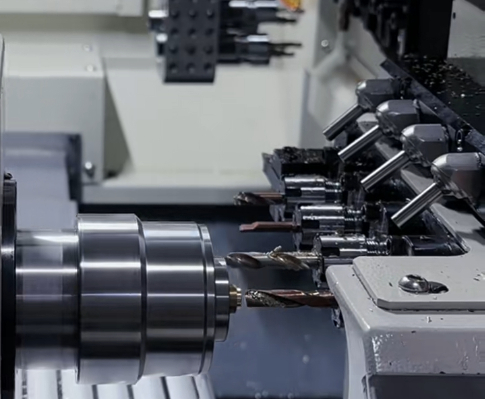
Cutting Force Causes Elastic Deflection – Thin Walls Push Away
When a milling cutter touches a thin wall, the cutting force pushes the wall away. This is called tool deflection or wall push‑off. The wall is in bending stress. It deflects elastically. The cutter removes less material than planned. The part becomes oversize. For thin walls under 1.5mm, this can cause a size error of 0.1mm or more.
Residual Stress Release – Warping After Machining
Metal blocks have internal stress from rolling or heat treatment. When you cut material away, the balance of stress changes. The part moves. This is stress relief warping. A flat plate may curl after you machine both sides. A long shaft may bend. You cannot see this coming. It happens after the cut.
Thermal Stress – Heat Expansion and Contraction
Cutting makes heat. The tool gets hot. The part gets hot. Hot metal expands. When the part cools, it shrinks. This creates thermal stress. If the part is clamped tight, the stress stays inside. The part may warp after you take it out of the vise.
The table below shows common stress‑related defects and their solutions.
| Defect | Cause | Solution |
|---|---|---|
| Thin wall oversize | Cutting force pushes wall | Use a sharp tool. Take light cuts. Use a backing support. |
| Part warps after machining | Residual stress released | Use stress‑relieved material. Rough, then rest, then finish. |
| Hole moves after boring | Stress from previous cuts | Rough boring first. Stress relief. Finish boring. |
| Surface waviness | Machine chatter (vibration) | Increase tool rigidity. Reduce speed. Change tool path. |
3. The Mechanical Root Causes of Part Failure
Parts fail because stress exceeds strength. Two common patterns show up in CNC parts.
Stress Concentrations Lead to Fatigue Fracture
Sharp corners. Small holes. Thread roots. These features pull stress into a small area. The stress at the corner is much higher than the average stress. This is called a stress concentration. If the load is repeated (cyclic), a crack starts at the stress concentration. The crack grows. The part breaks.
-
Design fix: Use large fillets. Avoid sharp internal corners. Put threads away from high‑load areas.
Assembly Preload and Working Load Combine
A bolt clamps a part. The bolt has preload (tension). Then the machine adds a working load. The two loads add together. The part sees higher stress. If you did not design for this combination, the part can yield or fatigue.
4. Expert Insight: Machining Is a Controlled Stress Event
“I tell young engineers: every cut you make is a stress event. The tool pushes the material. The material pushes back. If you ignore this, your parts will be wrong. I have seen a 2mm wall that should have been 1.9mm but came out 2.15mm because the cutter pushed it away. We changed to a smaller end mill, took a finish pass, and the size came right. You cannot avoid stress in machining. You must understand it and plan for it.”
— Senior Manufacturing Engineer, DongGuan YiTai Electronic Technologies
We Manage Stress and Strain in Programming, Fixturing, and Cutting
At DongGuan YiTai Electronic Technologies , we design our CNC processes to control stress. We use:
-
Stress‑relieved material: For tight flatness or straightness.
-
Rough‑rest‑finish sequence: To let residual stress release before final cuts.
-
Sharp, correct tools: To reduce cutting force and deflection.
-
Vacuum fixtures: For thin parts, to stop bending.
-
Finishing cuts with low depth and low feed: To minimize heat and residual stress.
We understand material mechanics. We apply it to your part. Send us your drawing. We will give you a process that respects the physics of metal.
5. Frequently Asked Questions (FAQ)
Q: What is the difference between stress and strain?
A: Stress is a force divided by area. It is internal pressure. Strain is the change in shape divided by the original size. Stress causes strain. Strain is the result.
Q: Why does a machined part sometimes bend after you remove it from the vise?
A: The vise clamps the part. Clamping adds stress. When you machine the top, you remove material. The stress balance changes. When you unclamp, the part moves to a new balance. This is residual stress release. Use less clamping force or machine both sides equally.
Q: What is a safe stress level for a CNC machined part?
A: You should design so the maximum working stress stays below the yield strength. For parts with cyclic loads, keep stress below the fatigue limit. Design safety factors are usually 2‑3x for static loads and 3‑5x for cyclic loads.
Q: How do you reduce stress concentration in a design?
A: Add fillets (radiuses) at sharp corners. Use large, smooth transitions. Put holes away from edges. Avoid sharp notches. A simple round corner can reduce stress concentration by 50%.
Q: Can heat treatment cause stress?
A: Yes. Heat treatment can add or remove stress. Quenching creates high thermal stress and can cause distortion. Tempering reduces stress. For critical parts, use a stress‑relief cycle before final machining.
Q: Does DongGuan YiTai Electronic Technologies offer stress‑relief heat treatment?
A: Yes. We coordinate stress‑relief annealing for steel and aluminum parts. We also plan the machining sequence to manage residual stress. Contact us with your part geometry and material. We will design the complete process.
DongGuan YiTai Electronic Technologies Co.,Ltd
DongGuan YiTai Electronic Technologies Co.,Ltd is a manufacturing service provider located in Dongguan, China.
YiTai specialized in CNC turning machining and sheet metal fabrication mainly. As a member of Hung Mou Group, we focus on the overseas marketing development. And based on our parent company’s manufacturing capability and resources, YiTai also expended machining services such as die casting, injection molding, aluminum profile extrusion, 3D printing, which are committed to providing customers with one-stop purchasing services and experience.
CNC MACHINING , CNC MILLING , CNC TURNING , SHEETMETAL , FASTENER , OTHERS




Buying A36 Carbon Steel Parts – How to Select a CNC Supplier and Ensure Qualified Delivery of Cost‑Effective Precision Parts
Enter the Bronze Family: A Complete Guide to the Most Common Bronze Alloys for CNC Precision Machining – Tin Bronze, Aluminum Bronze, Silicon Bronze and More
Related Article