Cold Heading Process for Fasteners and Precision

Table of Contents
1. Introduction to Cold Heading

Cold heading is a high-speed forging process where metal wires are shaped at room temperature using dies and punches. Dominating fastener manufacturing (screws, bolts, rivets), it replaces machining for complex geometries like heads, grooves, and undercuts. Compatible materials range from carbon steel and stainless steel to copper, aluminum, and titanium alloys. Modern multi-station cold headers perform cutting, heading, threading, and trimming in one automated cycle, achieving production rates of 300–500 parts per minute.
2. Key Characteristics of Cold Heading
Process Fundamentals
-
Plastic deformation at room temperature under extreme pressure (up to 2,500 MPa).
-
Demands high-purity materials with strict chemical/mechanical properties.
-
Generates work hardening – improving strength but limiting maximum deformation.
Advantages & Limitations
-
✅ Near-net-shape accuracy (reduces secondary operations).
-
✅ Material savings (near-zero scrap vs. machining).
-
✅ High-volume suitability (e.g., 1M+ units per day).
-
❌ High machine/tooling investment.
-
❌ Design restrictions (avoid sharp corners, extreme aspect ratios).
3. Factors Affecting Precision
Material Properties
| Factor | Impact on Precision |
|---|---|
| Chemical purity | Impurities cause brittleness/cracks. |
| Grain structure | Spheroidized pearlite = optimal flow. |
| Surface defects | Scratches/folds amplify during forming. |
Process Control
-
Temperature management: Heat generation must be minimized.
-
Strain rate: Affects material flow stability.
-
Stress state: Triaxial compression maximizes precision.
4. Cold Heading Machine Selection

Critical Features
-
Alloyed ductile iron frames for vibration absorption.
-
Precision-guided cutting systems (≤0.05mm repeatability).
-
VFD-controlled motors for speed optimization.
-
Closed-loop lubrication with micro-filtration.
Automation Trends
Modern machines integrate IoT sensors for real-time monitoring of:
-
Ejection forces
-
Tool wear
-
Dimensional drift
5. Material Requirements
Non-Negotiables
-
Spheroidized annealing: Achieves HRB 65–80 hardness.
-
Decarb control: ≤1% of wire diameter.
-
Surface quality: Oil-coated, defect-free wire.
-
Core hardness: 10–15% lower than surface.
? For custom alloys or exotic materials, see our guide: Custom CNC Machining Parts vs. Precision Cold Heading Parts.
6. Forming Oil Essentials
High-performance oils must deliver:
-
EP (Extreme Pressure) additives (e.g., sulfur-phosphorus compounds).
-
Thermal stability (>150°C operation).
-
Low-fog emission (meets OSHA/ISO 14001).
-
Corrosion inhibitors for in-process protection.
Example: For stainless steel M3 thumb screws, use chlorinated oils with 15%+ EP additives.
7. Expert Insights
Dr. Elena Rodriguez, MIT Manufacturing Lab:
"Cold heading’s precision hinges on strain homogeneity. Today’s FEA simulations predict material flow within 2% accuracy, slashing trial runs. For micro-fasteners like M3 thumb screws, nano-coated tools (TiAlN) boost die life by 300%."
8. Case Study: M3 Thumb Screw Production
Process Flow

-
Wire prep: 304 stainless steel, spheroidized annealed.
-
1st blow: Flatten head & imprint knurl pattern.
-
2nd blow: Form wing geometry.
-
Thread rolling: Flat-die rolling (60–80% thread depth).
Precision Metrics
| Parameter | Tolerance |
|---|---|
| Head diameter | ±0.05mm |
| Knurl depth | ±0.01mm |
| Thread pitch | ISO 6g |
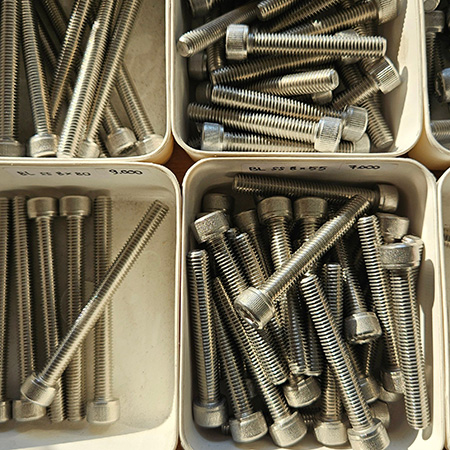
Explore our M3 Thumb Screw specifications.
9. Industry FAQs
Q1: Why choose cold heading over machining?
A: Cost efficiency for volumes >10,000 units, superior grain flow continuity, and 3–5× faster cycle times.
Q2: Can cold heading handle thread forming?
A: Threads are typically added via secondary rolling – cold heading creates pre-forms only.
Q3: What materials pose challenges?
A: Titanium (high springback) and 400-series stainless (work hardening >35%).
Q4: How to reduce tooling costs?
A: Use modular dies and simulate forming stages digitally before cutting steel.
Q5: Is cold heading viable for prototypes?
A: Yes – with soft tooling (P20 steel) for runs under 5,000 pieces.
10. Conclusion
Cold heading remains the cornerstone of precision fastener manufacturing, blending efficiency with metallurgical superiority. As Industry 4.0 transforms monitoring and control, tolerances below ISO 4753 Class 6 are now routine. For specialized applications – from aerospace fasteners to medical micro-components – mastering material science and tooling design is non-negotiable.
Ready to optimize your cold heading process? [Contact us] for a feasibility analysis on your next project.
DongGuan YiTai Electronic Technologies Co.,Ltd
DongGuan YiTai Electronic Technologies Co.,Ltd is a manufacturing service provider located in Dongguan, China.
YiTai specialized in CNC turning machining and sheet metal fabrication mainly. As a member of Hung Mou Group, we focus on the overseas marketing development. And based on our parent company’s manufacturing capability and resources, YiTai also expended machining services such as die casting, injection molding, aluminum profile extrusion, 3D printing, which are committed to providing customers with one-stop purchasing services and experience.
CNC MACHINING , CNC MILLING , CNC TURNING , SHEETMETAL , FASTENER , OTHERS




Precision in Every Circuit: How CNC Machining Powers the Electronics Industry
Essential Metals in Hardware Manufacturing: Properties, Applications & Selection Guide
Related Article