
Something about cnc you must need to know
author: Yitech
2024-12-05

Our company provides high-quality CNC machined service to meet the needs of various industries...
CNC milling is one of the important product processing methods, this article will introduce CNC processing methods through simple graphics, understand how to optimize products, while reducing costs, including rounded corners, chamfer, setting, drilling to text processing suggestions, designers can definitely have a further understanding of CNC after reading!
About CNC milling machines
CNC is a computer-controlled milling tool that processes raw materials by cutting tools. First look at the diagram to learn the name of the section:,
CNC is a computer-controlled milling tool that processes raw materials by cutting tools. First look at the diagram to learn the name of the section:,
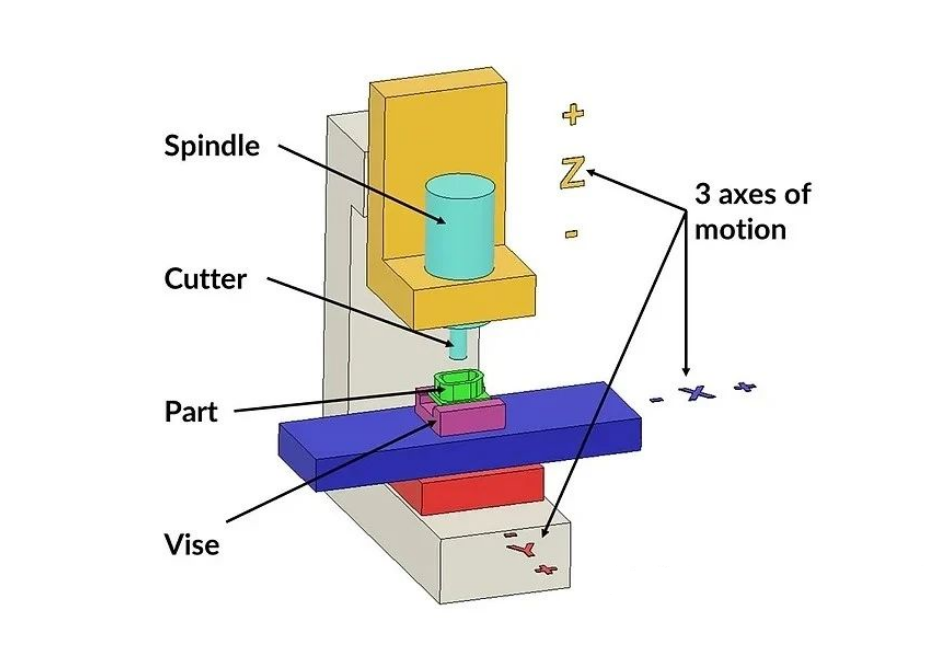
Usually the engineer will first fix the (Part) to be processed by (Vise), and then fix it to the CNC workbench, and the (Tool, Cutter) on the machine can freely cut the material in three axial directions. Although there are more advanced 4-axis and 5-axis processing machines, understanding the three-axis milling machine is the first step in mastering the manufacturing process.
Tools
There are many types of Tools in the field of CNC machining, and several basic types are introduced here:

From left to right are Flat End Mill, Bull Nose End Mill, Ball End Mill, Drill.
Flat End Mill: Or flat bottom knife, is the most common type of milling cutter, can be used for material hollowing and vertical wall machining.
Bull Nose End Mill: It similar to a flat mill, but with a smaller radius at the corner to improve tool strength, suitable for rapid material removal, or to retain a smaller bottom radius on the workpiece.
Ball End Mill: Suitable for complex 3D shapes and large bottom radius machining.
Drill: Used only to create vertical holes in parts.
Low Aspect End Mills
Because the milling cutter is cantilever, every time the length of the same diameter of the milling cutter increases by 1 times, the "Deflection" will increase by 8 times, and the processing time needs to be greatly reduced to ensure the accuracy of the workpiece. Therefore, when processing, it is usually hoped to choose the shortest length and the largest diameter of the tool, that is, the low aspect ratio tool.
As can be seen in the image below, both milling cutters apply the same force, but the milling cutter on the right is twice as long, resulting in greater deflection.
Therefore, when designers design parts, they can consider the length of the milling cutter required for the workpiece, and the use of short milling cutters with large diameters will shorten the processing time, and naturally reduce the cost of parts.
Therefore, when designers design parts, they can consider the length of the milling cutter required for the workpiece, and the use of short milling cutters with large diameters will shorten the processing time, and naturally reduce the cost of parts.


Internal Fillets
As large as possible, large diameter tools can be used, which helps to reduce processing time. As a rule of thumb, R should be greater than 1/3 of H. Therefore, a 12 mm deep groove should use at least 4 mm rounded corners, of course, you can also design smaller internal rounded corners, but the cost of parts will be relatively increased.
Fillet Specifics
According to their own tool size, as far as possible to maintain a large radius of the inner corner, so that when the tool moves to the corner, it will not rapidly increase its cutting amount, resulting in tool breakage. Therefore, if the tool used is a milling cutter with a diameter of 10 mm (radius of 5 mm), the rounded corner of the part should be larger, such as 6 mm.


Dog Bone Corners
If the jointed part must have a square corner, a dog-bone Angle should be used. Keep the diameter of the rounded corners cut as large as possible.
Feature Height
The height of the machining feature should be less than 4 times the width. The high and thin appearance will vibrate violently during machining, resulting in poor tolerances and surface smoothness.
Tapped Holes
thru holes are easier to work with than blind holes because thru holes expel chips. However, it should be noted that the depth of tapping should not exceed 3 times the aperture, which will not only increase the strength, but is difficult to manufacture and penetrate tight objects.
In addition, the same tapping device is difficult to tap the thread to the bottom of the hole, which needs to be replaced by a technician. Therefore, the depth of the blind hole needs to be 0.5 times more than the extension diameter.
In addition, the same tapping device is difficult to tap the thread to the bottom of the hole, which needs to be replaced by a technician. Therefore, the depth of the blind hole needs to be 0.5 times more than the extension diameter.
Stock Size
The designer can contact the supplier to obtain a catalogue to ensure that the finished part is suitable for the available material dimensions.
In order for the fixture to be able to grasp, the material needs to be 3mm below the distance, and at least 1mm more distance, there will be excess space for processing, to ensure that the parts look good and the size is accurate.
In order for the fixture to be able to grasp, the material needs to be 3mm below the distance, and at least 1mm more distance, there will be excess space for processing, to ensure that the parts look good and the size is accurate.


Chamfer and Deburr
If a sharp edge is needed on the part, simply mark it as "broken edge" on the computer engineering drawing, and the technician will be able to deburr the edge.
When you really need a specific size, you need to model the chamfer, if you use a 45 degree chamfer, you can use the most common tool, and different widths of the chamfer can be made with the same tool.
When you really need a specific size, you need to model the chamfer, if you use a 45 degree chamfer, you can use the most common tool, and different widths of the chamfer can be made with the same tool.
Reduce Setups
Each time the part is fixed in the fixture and positioned, it is called the "frame". Reducing the number of aircraft can reduce the processing time, is one of the most important keys to reduce costs.
Because all the tool paths of the three-axis CNC are from the vertical direction, machining the side requires the workpiece to be removed from the fixture and turned over, which requires manpower and will take some time, and will bring the opportunity for error.


Fillet External Corners
You can make small rounded corners on all the outer corners of the part without adding any cost. This reduces sharp edges and eliminates weak corners that can easily damage or scratch other parts.
Bosses for Tight Tolerance Areas
If the underside of the product requires a high degree of flatness, it is recommended to design a small boss with a small area, which can reduce the area requiring low tolerances and can more easily adjust the part to meet the required tolerances.


Drilling
The drill depth should be less than 6 times the aperture, otherwise special tools are required, or the joint must be drilled from both sides of the workpiece, but the joint may be incorrect. It is not necessary to specify the hole of the flat bottom, which is not only not easy to process, but also requires special tools.
The drill depth should be less than 6 times the aperture, otherwise special tools are required, or the joint must be drilled from both sides of the workpiece, but the joint may be incorrect. It is not necessary to specify the hole of the flat bottom, which is not only not easy to process, but also requires special tools.
Bottom Edge Fillets
In the case of a deep bottom, to avoid the guide Angle along the bottom of the groove, because it may be difficult to manufacture, if necessary, please choose the common knife Angle radius of the nose milling cutter, which can allow the technician to have some flexibility in processing. If you are not sure which tool to use, make the rounded corners as large as possible.
In the case of a deep bottom, to avoid the guide Angle along the bottom of the groove, because it may be difficult to manufacture, if necessary, please choose the common knife Angle radius of the nose milling cutter, which can allow the technician to have some flexibility in processing. If you are not sure which tool to use, make the rounded corners as large as possible.
Fillets for Edge Breaks
Do not fillet the edge of the top surface of the part, because the machining requires a tool specifically for this fillet radius, or the need to use a spherical milling cutter to slowly process the surface, if possible, use the easier to process C Angle, which can reduce costs.
Edge Drilling
Try to ensure that the entire diameter of the bit is within the workpiece, otherwise the hole may break and the surface smoothness will be poor. If necessary, drill a hole first and then whittle it down to the hole.
Try to ensure that the entire diameter of the bit is within the workpiece, otherwise the hole may break and the surface smoothness will be poor. If necessary, drill a hole first and then whittle it down to the hole.


3D Surfaces
CNC to cut complex surfaces, you need to use a large spherical knife to slowly process back and forth, the processing speed is very slow.
CNC to cut complex surfaces, you need to use a large spherical knife to slowly process back and forth, the processing speed is very slow.
Undercut
It is often difficult to process and requires special tools, or it must be achieved repeatedly. If absolutely necessary, the amount of concave should be as little as possible.


Text and Letters
Try to avoid designing raised text and replace it with concave text that can be cut with a V-shaped knife. To process the raised text requires cutting all the surrounding materials, and the text usually has many square internal corners, requiring a very small diameter milling cutter to process.
The above briefly introduces the CNC machining process and the places that need attention, so that designers can understand the appropriate processing methods, and successfully apply them to the products they design, which is easier to manufacture.
If you still want to know more, please follow us and contact us for your need!
CNC Machine VS CNC: They Are Certainly Not the Same!
Drive shaft maintenance
Related Article

Choosing between 316 and 316L? 316L resists weld decay better, 316 holds strength at higher heat. Both food-grade, both marine-grade. Quick, no-fluff breakdown.
316 vs 316L Stainless Steel for CNC Machining
What is stamping and when do you use it? A plain guide to sheet metal stamping, dies, and progressive tools, plus the parts it makes faster than machining.
What Is Stamping in Metal Manufacturing?

