CNC Honing: The Precision Surface Finishing Process for Cylinder Bores, Hydraulic Cylinders, and Critical Holes
1. What Is CNC Honing and How Does It Work?
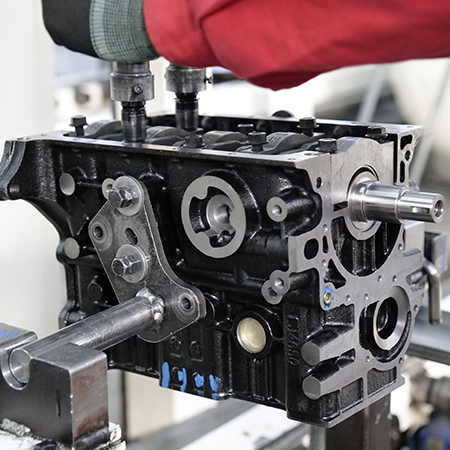
CNC honing is an abrasive machining process. It improves the dimensional accuracy, surface finish, and geometric form of cylindrical bores. The process uses a honing tool with expandable abrasive stones. The stones press against the bore wall while the tool rotates and strokes back and forth.
The result is a cross-hatch surface pattern. This pattern is not an accident. It is engineered. The cross-hatch holds lubricating oil in microscopic grooves. It allows piston rings to glide without metal-to-metal contact. And it controls the surface roughness to a precise specification — usually Ra 0.2 to 0.8 μm.
CNC honing controls three motions simultaneously:

1.1 Honing vs. Boring vs. Reaming vs. Grinding: A Process Comparison
There are four ways to finish a cylindrical bore. Each has different capabilities. Each has different costs. Here is the comparison:
| Property | CNC Honing | CNC Boring | Reaming | Internal Grinding |
|---|---|---|---|---|
| Surface roughness (Ra) | 0.2–0.8 μm | 0.8–3.2 μm | 0.4–1.6 μm | 0.1–0.4 μm |
| Dimensional tolerance | ±0.005 mm | ±0.01 mm | ±0.02 mm | ±0.002 mm |
| Cylindricity | 0.002 mm | 0.01 mm | 0.005 mm | 0.001 mm |
| Straightness | 0.003 mm / 100 mm | 0.01 mm / 100 mm | 0.01 mm / 100 mm | 0.002 mm / 100 mm |
| Cross-hatch pattern | Yes — controllable | No | No | No (single direction) |
| Max bore diameter | 5–500 mm | 3–1,000 mm | 2–100 mm | 5–300 mm |
| Material hardness limit | Up to 65 HRC | Up to 45 HRC | Up to 35 HRC | Up to 70 HRC |
| Stock removal | 0.02–0.2 mm | 0.5–5 mm | 0.1–0.5 mm | 0.02–0.5 mm |
| Relative cost | Medium | Low | Low | High |
| Best for | Functional bores needing oil retention | Bulk material removal | Simple precision holes | Ultra-precision, hard materials |
1.2 The Cross-Hatch Pattern: Why It Matters for Functional Surfaces
The cross-hatch is the signature of a honed surface. Two sets of grooves cross each other at a specific angle — usually 30° to 60°. This angle is not random. It is controlled by the ratio of rotation speed to stroke speed.
Why does this matter?
- Oil retention: The grooves hold lubricating oil. Without them, the bore would run dry. Metal would rub on metal. The surface would scuff and fail.
- Debris trapping: The cross-hatch traps small particles of wear debris. This prevents them from scratching the piston or ring surface.
- Sealing: Piston rings ride on the oil film held by the cross-hatch. A proper cross-hatch angle gives the best seal — less blow-by, more compression, better fuel economy.
- Break-in control: The cross-hatch gives the piston rings a controlled surface to wear into. Too smooth, and the rings never seat. Too rough, and they wear out fast. Honing hits the sweet spot.

"Honing is the only process that gives you both precision and function. Boring gives you a round hole. Grinding gives you a smooth hole. But only honing gives you a hole that actually works — a surface that holds oil, seals rings, and survives millions of cycles."
— Dr. Hiroshi Tanaka, Professor of Tribology, Tokyo Institute of Technology
2. Applications Where CNC Honing Is Essential
2.1 Engine Cylinder Bores, Hydraulic Cylinders, and Valve Bodies
CNC honing is critical in three main product families:
| Application | Why Honing Is Required | Typical Tolerance | Surface Spec |
|---|---|---|---|
| Engine cylinder bores | Piston ring sealing, oil retention, heat dissipation | ±0.01 mm | Ra 0.4–0.8 μm, 45° cross-hatch |
| Hydraulic cylinders | Seal life, low friction, pressure retention | ±0.005 mm | Ra 0.2–0.4 μm |
| Valve bodies | Spool clearance, leak prevention, smooth actuation | ±0.003 mm | Ra 0.1–0.4 μm |
| Connecting rod bores | Bearing crush, roundness under load | ±0.005 mm | Ra 0.4 μm |
| Gear bushings | Shaft clearance, oil film stability | ±0.01 mm | Ra 0.4–0.8 μm |
| Brake master cylinders | Seal integrity, pedal feel consistency | ±0.005 mm | Ra 0.2 μm |
| Pump sleeves | Impeller clearance, efficiency | ±0.01 mm | Ra 0.4 μm |

2.2 Material Compatibility: From Cast Iron to Hardened Steel
CNC honing works on a wide range of materials. The abrasive stone selection changes based on material hardness:
| Material | Hardness | Recommended Stone | Grit Size | Removal Rate |
|---|---|---|---|---|
| Gray cast iron | 180–220 HB | SiC (silicon carbide) | 120–220 | Fast |
| Steel (mild) | 120–200 HB | Al₂O₃ (aluminum oxide) | 150–280 | Medium |
| Hardened steel | 45–60 HRC | CBN (cubic boron nitride) | 180–400 | Medium |
| Stainless steel | 200–300 HB | Al₂O₃ + SiC blend | 180–320 | Slow |
| Aluminum | 60–150 HB | SiC | 220–400 | Fast (careful — galling) |
| Bronze / brass | 60–120 HB | SiC | 220–320 | Fast |
| Nickel alloy | 200–400 HB | CBN or diamond | 280–600 | Slow |
For hardened steel above 55 HRC, only CBN or diamond stones work. Conventional abrasives wear out before they cut the material. CBN stones cost more — $80–$300 per stone — but they last 10 to 50 times longer than aluminum oxide. For production runs, CBN is cheaper per part.
3. CNC Machining Capabilities That Support Honing Production

3.1 Integrated CNC Boring and Honing for One-Stop Delivery
Honing is a finishing operation. It removes only 0.02 to 0.2 mm of material. The bore must be pre-machined first — usually by CNC boring or CNC turning. At DongGuan YiTai, we do both in-house:
3.2 Tolerances, Surface Roughness, and Geometric Accuracy
Here is what CNC honing can achieve in production:
| Parameter | CNC Honing Capability | Industry Standard |
|---|---|---|
| Diameter tolerance | ±0.005 mm | ±0.01 mm |
| Cylindricity | 0.002 mm | 0.005 mm |
| Roundness | 0.001 mm | 0.003 mm |
| Straightness | 0.003 mm / 100 mm | 0.01 mm / 100 mm |
| Surface roughness (Ra) | 0.2–0.8 μm | 0.4–1.6 μm |
| Cross-hatch angle | 30°–60° (controllable) | 30°–60° |
| Bore diameter range | 5–300 mm | — |
| Bore depth range | Up to 500 mm | — |
| Material hardness | Up to 65 HRC | — |
"The gap between a good bore and a great bore is 5 microns. That is the difference between a hydraulic cylinder that lasts 10,000 hours and one that leaks at 2,000. Honing is where that 5-micron difference is made."
— Erik Lindqvist, Chief Engineer — Hydraulic Systems, Bosch Rexroth
4. How DongGuan YiTai Delivers Precision-Honed Components
One Facility. Full Bore-to-Finish Process. Zero Outsourcing.
At DongGuan YiTai Electronic Technologies, we combine CNC boring, CNC milling, CNC turning, and CNC honing under one roof. Your part goes from raw material to honed finish without leaving our facility. No shipping between suppliers. No quality gaps. No delays.
Our CNC honing and machining capabilities:
- CNC vertical honing machine: Bore diameter 5–300 mm, depth up to 500 mm
- CNC horizontal boring mill: For pre-honing bore preparation
- 3-axis and 4-axis CNC machining centers: For external features, flanges, mounting holes
- CNC turning centers: For round parts and bushings
- Honing tolerance: ±0.005 mm diameter, 0.002 mm cylindricity
- Surface finish: Ra 0.2–0.8 μm with controllable cross-hatch angle
- Materials: Cast iron, steel, hardened steel (to 65 HRC), stainless, aluminum, bronze
- Abrasive stones: SiC, Al₂O₃, CBN, diamond — selected per material
- Inspection: Bore gauge (Mitutoyo), air gauge, surface roughness tester, roundness machine
- Surface treatment: Anodizing, plating, black oxide, passivation (in-house)
- Batch size: 1 piece (prototype) to 10,000 pieces (production)
- Lead time: 7–10 days (prototype), 3–4 weeks (production)
What makes us different:
- We control the entire process — from rough boring to final honing. The geometry is controlled at every step, not just at the end.
- We provide full inspection reports with every batch — bore diameter, cylindricity, roundness, and surface roughness data.
- We can handle both internal and external features — a part with a honed bore, milled flange, and drilled mounting holes is done in one facility.
- We select the right abrasive stone for your material — no "one stone fits all" shortcuts.
Need Precision-Honed Bores for Your Components?
Send us your drawing with bore diameter, tolerance, and surface finish spec. We will review it and send you a quote in 24 hours. Full process under one roof — from boring to honing to finishing.
Request Your Honing Quote5. Frequently Asked Questions
DongGuan YiTai Electronic Technologies Co.,Ltd
DongGuan YiTai Electronic Technologies Co.,Ltd is a manufacturing service provider located in Dongguan, China.
YiTai specialized in CNC turning machining and sheet metal fabrication mainly. As a member of Hung Mou Group, we focus on the overseas marketing development. And based on our parent company’s manufacturing capability and resources, YiTai also expended machining services such as die casting, injection molding, aluminum profile extrusion, 3D printing, which are committed to providing customers with one-stop purchasing services and experience.
CNC MACHINING , CNC MILLING , CNC TURNING , SHEETMETAL , FASTENER , OTHERS




What Is Milling? A Complete Guide to the CNC Machining Process, Operations, and Capabilities
XRF Coating Thickness Measurement Equipment: How It Ensures Anodizing Quality in Precision Manufacturing
Related Article