Complete Guide to Brass Insert Nuts: Types, Functions, and Key Applications in CNC Precision Machining
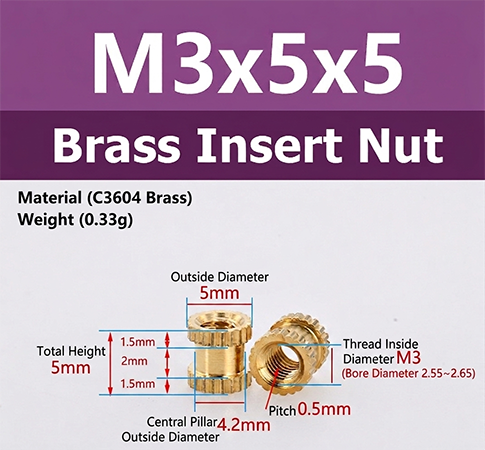
This guide explains what brass insert nuts are. It shows the different types. It tells you how they are used in CNC machined parts.
1. What Is a Brass Insert Nut? – Strong Threads for Soft Materials
A brass insert nut is a small metal cylinder with threads inside. You put it into a hole in plastic, aluminum, or other soft material. The outside of the insert has knurling, barbs, or a groove. These features lock the insert in place. The inside has a standard thread (like M3, M4, or #4-40).
Why Brass?
Brass is the best material for insert nuts. Three reasons.
-
Excellent machinability: Brass cuts easily. You can make small, precise inserts.
-
Good corrosion resistance: Brass does not rust. It works well in indoor and outdoor products.
-
Heat match for plastics: Brass heats up fast. It melts into plastic without burning it. This is key for heat insertion.
-
Good thermal conductivity: Heat moves from the insert into the plastic quickly. The plastic cools and shrinks around the insert.
2. Main Types of Brass Insert Nuts
There are four common types. Each one goes into the plastic in a different way.
| Type | Installation Method | Outside Features | Best For |
|---|---|---|---|
| Heat (Thermal) Insert | Heat the insert. Press into a drilled hole. | Knurling or diamond knurl | General plastic parts. High pull-out strength. |
| Molded Insert | Place in mold before injection. Plastic flows around it. | Hexagonal or knurled | High-volume molded parts. No post-molding step. |
| Press-in (Self-tapping) Insert | Push into hole with a press. No heat. | Sharp barbs or thread-forming flutes | Soft plastics. Quick assembly. Lower strength. |
| Ultrasonic Insert | Ultrasonic horn vibrates the insert into the plastic. | Knurled or stepped | Fast, clean installation. Sensitive electronics. |
Heat (Thermal) Insert
This is the most common type for CNC machined plastic parts. You heat the insert to about 200–250°C. The hot insert melts the plastic as you push it in. Then the plastic cools and grips the knurling.
-
Pros: Very strong. Good repeatability. Low equipment cost (a soldering iron with a tip).
-
Cons: Takes a few seconds per insert. Not for thin walls (plastic may melt through).
Molded Insert
You put the insert into the injection mold before the shot. The melted plastic flows around it. The insert is trapped inside the part.
-
Pros: No post-processing. The insert is fully encapsulated. Very strong.
-
Cons: Only for injection molded parts. Not for CNC machined parts from solid stock.
Press-in (Self-tapping) Insert
These inserts have sharp barbs on the outside. You press them into a drilled hole with a hand press or arbor press. The barbs bite into the plastic.
-
Pros: No heat. No special tools. Fast.
-
Cons: Lower pull-out strength. The insertion force can split thin walls.
Ultrasonic Insert
An ultrasonic horn vibrates at 20–40 kHz. The vibrations create friction heat. The insert melts into the plastic.
-
Pros: Very clean. No external heat source. Good for assembled parts (put insert in last).
-
Cons: Expensive ultrasonic welder. Not for all plastics.
3. Two Roles of Brass Insert Nuts in CNC Precision Machining
Brass insert nuts appear in CNC work in two ways.
Role 1: CNC Machined Brass Insert Nuts (Custom Sizes)
Sometimes standard insert sizes do not fit. The part needs a non-standard thread. Or the length is special. In this case, we machine the insert nut itself on a Swiss lathe or CNC lathe. We start from a brass bar. We turn the outside knurling or grooves. We drill and tap the inside thread. We cut it to length.
-
When to use: Small quantities (50–500 pcs). Custom thread sizes. Special outside shapes (flanges, shoulders).
-
Advantage: You get exactly what you need. No minimum order from a catalog.
Role 2: Machining the Installation Hole for Standard Inserts
Most of the time, you buy standard brass insert nuts from a supplier. But the plastic or metal part that holds them is CNC machined. You must machine the correct hole size and depth.
-
Hole size: The insert datasheet gives a hole diameter. Usually a slip fit (0.05–0.1mm larger than the insert OD).
-
Hole depth: Must be slightly deeper than the insert length. Leave room for displaced plastic.
-
Counterbore or chamfer: A small chamfer at the hole entry helps guide the insert.
We machine these holes with high precision. The hole tolerance is typically ±0.02mm. Too tight, the insert splits the part. Too loose, the insert spins or pulls out.
4. Typical Industries That Use Brass Insert Nuts
Brass inserts are everywhere. Here are four main industries.
| Industry | Application | Why Brass Insert? |
|---|---|---|
| Consumer Electronics | Phone cases, laptop frames, smartwatch housings | Small size, high strength, many assembly/disassembly cycles |
| Automotive Interior | Dashboard panels, control modules, door handle components | Vibration resistance, temperature stability |
| Medical Devices | Handheld diagnostic tools, monitor housings, surgical tool handles | Corrosion resistance, ability to sterilize (autoclave safe) |
| Industrial Equipment | Electrical junction boxes, PLC enclosures, instrument panels | Thread durability for field service, chemical resistance |
Consumer Electronics
A plastic phone case needs screws to hold the circuit board. Brass inserts go into the plastic posts. The screws go into the inserts. The inserts can take many screw cycles without stripping.
Automotive Interior
Car dashboards get hot and cold. They also vibrate. A brass insert holds better than a self-tapping screw into plastic. It will not loosen over time.
Medical Devices
Medical equipment is cleaned with harsh chemicals. Brass resists corrosion. Some brass alloys are also antimicrobial. Inserts in medical device housings allow easy disassembly for repair or battery change.
Industrial Equipment
Field technicians open electrical boxes many times. The screws go in and out. A plastic thread would strip. A brass insert lasts for years.
5. Expert Insight: Heat vs Ultrasonic vs Press-In
“I have used all three methods. For most CNC machined plastic parts (ABS, PC, nylon), I recommend heat insertion. It is simple. A cheap soldering iron with a flat tip works. Hold the insert with tweezers. Heat it. Push it in. The plastic melts and flows around the knurling. The bond is very strong. Ultrasonic is cleaner but the machine costs thousands. Press-in is faster but weaker. For high-volume production, use molded inserts. For prototypes or low volume, heat insertion is the best balance of strength and cost.”
— Assembly Process Engineer, DongGuan YiTai Electronic Technologies
One-Stop Service: Custom Brass Insert Nuts + Precision Holes
At 'DongGuan YiTai Electronic Technologies' , we do both sides of the job. We can CNC machine custom brass insert nuts from free-cutting brass (C36000) in small batches. We also machine the plastic or aluminum housings with precision holes ready for standard inserts.
We work with all common thread sizes: M2 to M8, and inch threads (#2-56 to #1/4-20). We also install inserts for you (heat or press-in) if you send us the plastic parts.
Send us your drawing. Tell us the base material (plastic, aluminum, or other). Tell us the screw size. We will recommend the best insert type and give you a quote.
6. Frequently Asked Questions (FAQ)
Q: What is the difference between a brass insert and a threaded insert?
A: Brass insert refers to the material. Threaded insert is the general name. Most threaded inserts are brass. Some are stainless steel or aluminum. Brass is the most common because it machines well and resists corrosion.
Q: Can I put a brass insert into aluminum?
A: Yes. But you must use a press-in type with sharp barbs. Do not use heat insertion. Aluminum has a much higher melting point than plastic. Heat will not work. For aluminum, drill a hole slightly smaller than the insert OD. Press the insert in with a vise or arbor press.
Q: How do I choose the right hole size for a heat insert?
A: Check the insert manufacturer’s datasheet. The hole diameter is usually 0.05–0.1mm larger than the insert body. The hole depth should be the insert length plus 0.5–1mm for displaced material. For example, an M3 insert that is 5mm long needs a 5.5mm to 6mm deep hole.
Q: What is the strongest type of brass insert?
A: Molded inserts (placed in the injection mold) are strongest. The plastic flows around the entire insert. Next is heat insertion, then ultrasonic, then press-in. For CNC machined parts (which are not injection molded), heat insertion gives the best strength.
Q: Can you make a brass insert with a flange (shoulder)?
A: Yes. We can CNC turn brass inserts with a flange. The flange sits on the surface of the plastic. This is good for thin walls. The insert cannot push through. Send us a sketch or CAD model of the custom shape.
Q: Does DongGuan YiTai Electronic Technologies offer standard brass insert nuts?
A: We do not stock large volumes of standard catalog inserts. But we can direct you to suppliers. For custom sizes, we machine inserts to your drawing. For standard sizes in small quantities (50–500 pcs), we can also machine them faster than you can order from a catalog. Send us your needs.
DongGuan YiTai Electronic Technologies Co.,Ltd
DongGuan YiTai Electronic Technologies Co.,Ltd is a manufacturing service provider located in Dongguan, China.
YiTai specialized in CNC turning machining and sheet metal fabrication mainly. As a member of Hung Mou Group, we focus on the overseas marketing development. And based on our parent company’s manufacturing capability and resources, YiTai also expended machining services such as die casting, injection molding, aluminum profile extrusion, 3D printing, which are committed to providing customers with one-stop purchasing services and experience.
CNC MACHINING , CNC MILLING , CNC TURNING , SHEETMETAL , FASTENER , OTHERS




CNC Machining in Drone Manufacturing: How to Make High-Precision, Lightweight Parts
Complete Guide to Stainless Steel CNC Machining: Material Types, Machining Challenges, and Best Practices
Related Article