Purchasing Aluminum Parts Made with Stamping + CNC: A Complete Supplier Selection and Project Management Handbook
This guide helps you select the right supplier. You will learn what to ask, how to read the quote, and how to control quality.
-
Evaluating a Supplier' s Stamping‑CNC Collaboration Capability
-
One Single Point of Responsibility – We Manage the Stamping Supply Chain
-
From Prototype to 10,000 Parts per Month – Our Project Launch Process and Lead Time Promise
1. Evaluating a Supplier' s Stamping‑CNC Collaboration Capability
Not every shop that stamps parts also does CNC. Many outsource the CNC step. That adds risk. Ask these three questions.
Do They Have In‑House CNC Machining or Depend on Outsourcing?
A supplier with in‑house CNC mills and lathes controls the whole process. They can adjust the CNC program if the stamping die changes. Outsourcing means longer lead times and finger‑pointing. Ask: “What percentage of your CNC work is done in‑house?”
Stamping Tooling Design and Manufacturing – Who Guarantees the Accuracy?
The stamping die determines the blank shape, hole positions, and flatness. A good supplier either:
-
Designs and builds the die in‑house, or
-
Works with a trusted local toolmaker.
Ask to see samples of their dies. A worn die leaves burrs and poor flatness. That makes CNC fixturing harder.
Incoming Inspection of Stampings and CNC Locating Datum Control
Stamped parts are not perfectly flat. They may have small twists. The supplier must measure each batch of stampings before CNC work. They also need a repeatable locating system (pin holes, edges) to load parts on the CNC machine. Without this, the CNC cuts in the wrong place.
| Capability | What to Ask |
|---|---|
| In‑house CNC? | Yes / No – ask for machine list |
| Stamping die source | In‑house or local partner |
| Incoming inspection | Do they measure each batch before CNC? |
| CNC fixturing | How do they locate the stamping? |
2. Full Cost Breakdown of the Quote
A hybrid quote has more line items than a simple machined part. Understand each one.
Tooling (Die) – One‑Time Cost
The stamping die is a one‑time expense. Cost depends on complexity:
-
Simple flat blank die: 500–500–1,500
-
Progressive die with bending: 3,000–3,000–10,000
-
Transfer die for complex parts: 10,000–10,000–30,000
Ask if the die cost includes any trial samples. Some suppliers amortize the die over the first batch.
Per‑Part Stamping Cost
This covers the sheet metal, press time, and die wear. For medium volumes (5,000 – 50,000 parts), stamping cost is very low – often 0.10–0.10–0.50 per part.
CNC Machining Time (Including Fixturing and Setup)
This is often the biggest cost. The stamping must be loaded into a vise or fixture. Cycle time depends on how many holes and features are machined. Typical CNC cost: 0.50–0.50–2.00 per part for small features.
Surface Finishing and 100% Inspection
-
Anodizing: 0.20–0.20–0.80 per part depending on size and color.
-
Plating or painting: similar range.
-
Full inspection (CMM or vision): adds 0.05–0.05–0.20 per part.
Shorter Lead Time and Overall Savings from Combining Processes
If you send stamping to one shop and CNC to another, you pay freight twice. You also wait for two queues. A single supplier who does both can cut lead time by 30–50% and reduce per‑part cost by 10–20% because of eliminated handling.
3. Key Quality Control Points
The transition from stamping to CNC is where defects happen.
First Article Inspection – Stamped Blank and Finished Part
The supplier should run the first article in two steps:
-
Measure the stamped blank (before CNC). Check contour, flatness, and hole positions.
-
After CNC, measure the final part again. Compare the two.
If the blank is already out of tolerance, the CNC cannot fix it.
Surface Quality Limits – Stamping Marks, Scratches, and Anodizing Appearance
Aluminum stamping can leave:
-
Die marks (shiny or dull lines)
-
Micro‑scratches from sheet movement
-
Small burrs on cut edges
Agree on an appearance limit. For visible parts, small marks may be acceptable. For cosmetic parts, require a polished or sandblasted finish before anodizing.
Batch CPK Report Requirement
For high volume, ask for a CPK report on critical CNC features (hole diameters, distances). A CPK ≥ 1.33 means the process is stable. The supplier should measure 30–50 random parts per batch.
4. One Single Point of Responsibility – We Manage the Stamping Supply Chain
At DongGuan YiTai Electronic Technologies , we focus on CNC machining. But we also manage the stamping step through trusted local partners. You do not have to find a stamping shop yourself. You do not have to coordinate between two vendors.
What you get:
-
One quote that covers stamping die, stamping, CNC, finishing, and inspection.
-
One quality standard (our CNC lab checks every stamped blank before machining).
-
One delivery date and one invoice.
-
If a stamped part is bad, we reject it at incoming – you never see it.
We have long‑term relationships with stamping toolmakers and press shops. We control the whole chain.
5. From Prototype to 10,000 Parts per Month – Our Project Launch Process and Lead Time Promise
We follow a five‑step launch process.
-
Design review (24‑48 hours): We look at your part. We suggest split lines and stamping‑friendly features. We give a DFM report.
-
Die build (2‑4 weeks): We quote the die separately. You approve the die sample.
-
Trial stamping + first CNC sample (1‑2 weeks): We stamp 20‑50 blanks. We CNC machine 5‑10 samples. We send you full CMM report and photos.
-
Small batch (100‑500 parts): We prove the process. We deliver CPK data.
-
Mass production (500 – 10,000 parts per month): We run weekly or monthly batches. Lead time from stamping to finished part is 10‑15 working days for medium volumes.
Our promise: No hidden die maintenance fees for the first 50,000 parts. Transparent pricing per batch.
6. Expert Insight: The Hidden Cost of Separate Suppliers
“I managed a project where we stamped parts at Shop A and CNC’d at Shop B. The stamping had a slight twist – only 0.3mm. Shop A said it was fine. Shop B loaded the part in a vise. The twist made the CNC cut off center. Holes were 0.2mm off. We scrapped 200 parts. The two shops blamed each other. That is why I always use a single supplier who controls both steps. If the stamping is bad, they catch it before CNC. One throat to choke.”
— Supply Chain Manager, Industrial Equipment Company
7. Frequently Asked Questions (FAQ)
Q: When should I use stamping+CNC instead of pure CNC from solid?
A: Use hybrid for high volume (5,000+ parts per year) and flat or shallow formed shapes. Stamping the blank saves material and rough cutting time. For complex 3D shapes or very small batches (under 500 parts), pure CNC from solid is cheaper.
Q: What aluminum alloys work best for stamping+CNC?
A: 5052‑H32 and 6061‑T6 are good. 5052 is more formable (bends without cracking). 6061 is stronger but may crack on sharp bends. 1100 is soft but too gummy for CNC. Avoid 7075 – it is too hard for most stamping dies.
Q: How much material does stamping save compared to machining from solid?
A: For a 150mm x 80mm x 3mm flat part, a solid block would need 150x80x3 = 36 cm³ of material. Stamping from a sheet uses the same 36 cm³ plus a small skeleton waste (15‑20%). So stamping saves 80% of material cost compared to machining from a thick plate.
Q: What is the typical tolerance for a stamped aluminum blank?
A: For a simple flat blank, ±0.1mm is typical. For a formed part with bends, ±0.2‑0.3mm is normal. The CNC then holds ±0.01‑0.02mm on machined features. Do not expect stamped features to be as precise as CNC.
Q: How do you handle warping after stamping?
A: We use a stress‑relief flattening press or a roller leveler. For thin parts (under 2mm), we specify a flatness of 0.1mm per 100mm. For thicker parts, we rely on the CNC fixture to clamp the part flat. If the warp is too severe, we reject the stamping batch.
Q: Does DongGuan YiTai Electronic Technologies build stamping dies in‑house?
A: We do not build dies ourselves. We partner with a local die shop that has 20+ years of experience. We manage the die design, approval, and maintenance. You deal only with us. Send your part drawing for a complete stamping+CNC quote.
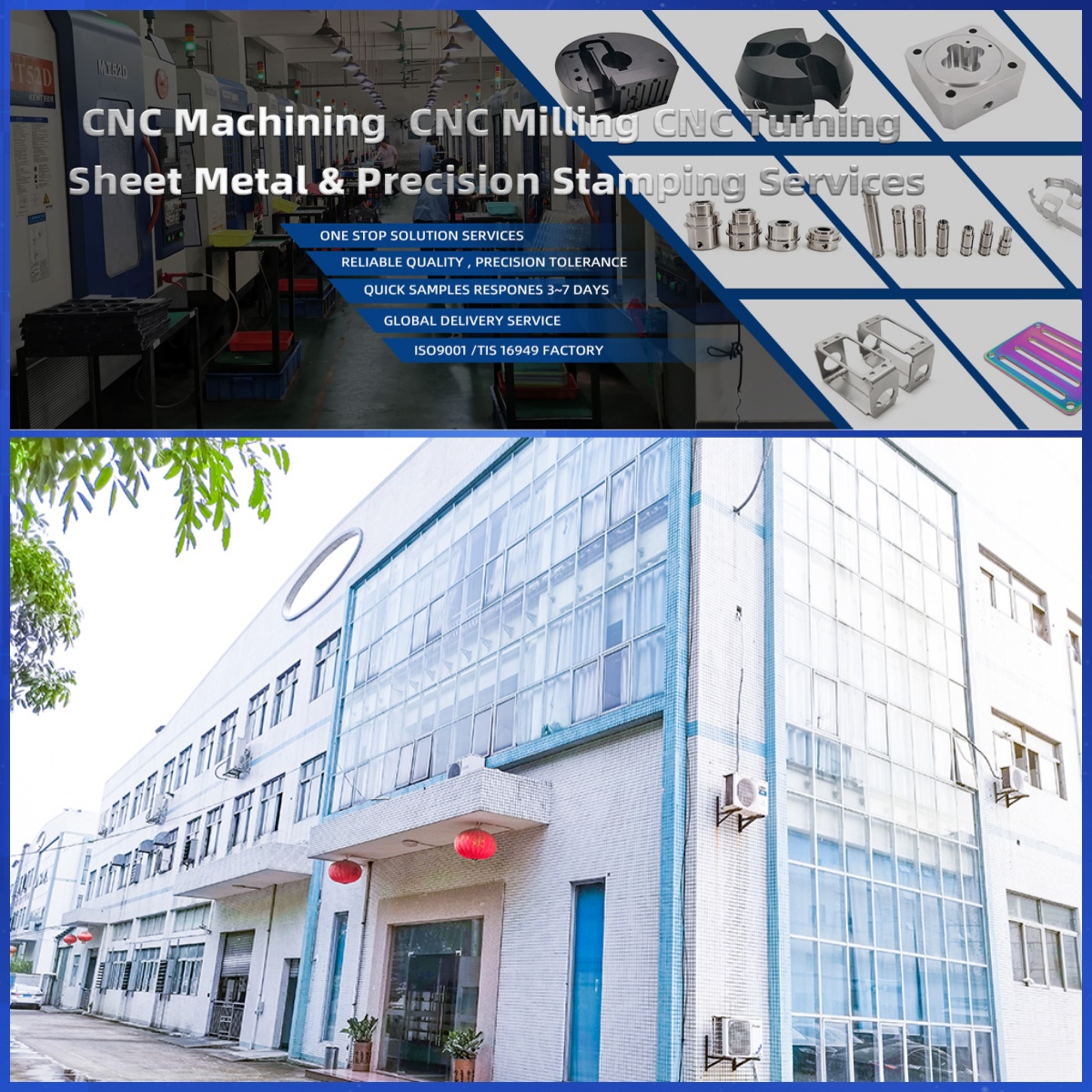
DongGuan YiTai Electronic Technologies Co.,Ltd
DongGuan YiTai Electronic Technologies Co.,Ltd is a manufacturing service provider located in Dongguan, China.
YiTai specialized in CNC turning machining and sheet metal fabrication mainly. As a member of Hung Mou Group, we focus on the overseas marketing development. And based on our parent company’s manufacturing capability and resources, YiTai also expended machining services such as die casting, injection molding, aluminum profile extrusion, 3D printing, which are committed to providing customers with one-stop purchasing services and experience.
CNC MACHINING , CNC MILLING , CNC TURNING , SHEETMETAL , FASTENER , OTHERS




High‑Strength Steel Selection Guide: 1075 vs 1095 vs 4140 – A Complete Showdown of Heat Treat Hardness, Machinability, and Application Scenarios
Mastering the Precision Manufacturing Code of Machinable Stainless Steel: From 303 to 17‑4PH – A Complete Guide to Grades and CNC Processes
Related Article