Aluminum and Aluminum Alloys (Part 2)

Aluminum and aluminum alloys have become increasingly popular in the aerospace industry due to their lightweight and strong properties, revolutionizing the way aircrafts are built, let's continue to learn more about these two kinds materials today...
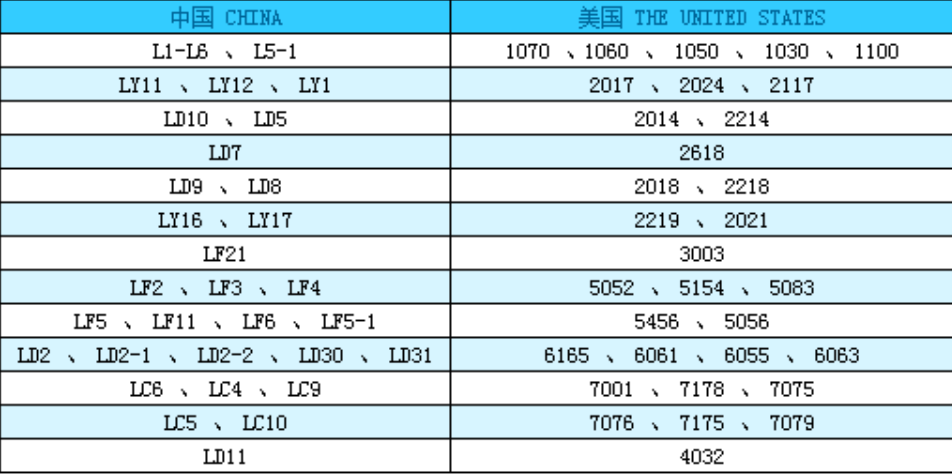
Comparison table of Chinese and American grades
Welding performance of aluminum and aluminum alloys
(1) Formation of pores
② The gas that forms pores is composed of multiple components, such as CO, H2 and N2.
③ Since aluminum-magnesium alloys do not contain carbon, there is no condition for the formation of CO pores, and nitrogen is insoluble in aluminum and its alloys. Therefore, it is generally believed that the pores in aluminum-magnesium alloy welds are hydrogen pores.
④ Hydrogen in the welding area can come from various sources. The moisture in the arc column atmosphere and the moisture adsorbed by the welding material and the oxide film on the surface of the parent material are the main sources. These moistures form bubbles in the molten pool under the action of the high temperature of the arc, and form pores before they can float out.
(2) Main factors affecting the formation of pores
② Argon flow rate and purity Argon flow rate is an important parameter affecting the protection effect of the molten pool. If the flow rate is too small, the argon stiffness is not enough, the ability to exclude the surrounding air is weak, and the protection effect is poor. However, if the flow rate is too large, it will not only waste argon, but also cause the laminar flow area of the ejected airflow to shorten, the turbulent area to expand, and the air to be drawn into the protection area, which will reduce the protection effect and make the weld prone to pores. This point is often overlooked during on-site welding. Therefore, it is necessary to select a suitable argon flow rate. The argon flow rate is related to the nozzle diameter. The purity of argon also has a great influence on the welding quality. Low purity and high impurities of argon can increase the hydrogen content in the arc column atmosphere, and also reduce the "cathode atomization" effect.
③ Welding process weldment groove preparation, assembly method and selection of welding process parameters are crucial to prevent the generation of pores. When the weldment is assembled, a gap is left at the root, which can effectively expose the oxide film to the arc action range. Changing welding parameters can affect the conditions of gas escape and dissolution into the molten pool. If the welding speed is too slow, the molten pool will be retained for a long time, increasing the amount of hydrogen dissolved; if the welding speed is fast, it is easy to produce incomplete penetration and incomplete fusion defects. Practice has proved that using a faster welding speed and a larger welding current can effectively prevent the generation of pores. Increasing the welding current can not only ensure root fusion, but also increase the stirring effect of the arc on the molten pool, which is conducive to the floating of bubbles in the root oxide film, thereby reducing the generation of pores.
④ Welding operation technology Mastering skilled operation skills is also an important link in preventing pores. The on-site welding position of aluminum-magnesium alloy pipelines is generally full-position welding. During welding, the spatial position of the metal molten pool is constantly changing, and the operation is difficult. However, the back tilt angle between the welding gun and the workpiece surface cannot be changed arbitrarily with the change of the molten pool position. If the angle is too small, turbulence will be generated on the inside, and the argon gas stiffness on the outside will be insufficient, and the gas protection molten pool effect will be poor. The cross joint method can be used for the horizontal pipe overhead welding joint to avoid dense pores at the joint. In addition, the tungsten electrode is too long, the arc is too long or unstable, etc., which may cause the pollution of the protective gas and cause pores in the weld.
⑤ Other influencing factors In addition to the above factors, attention should also be paid to the influence of environmental factors. In a high humidity environment, the inner wall of the welding wire or the argon transmission pipe is easy to absorb crystal water. Therefore, the lower the relative humidity of the welding environment, the better. Preheating is required when the ambient temperature is below 5 ℃. In order to avoid excessive temperature and reduce the alloy's resistance to stress corrosion cracking, the preheating temperature should not exceed 150 ℃. A gas welding gun can be used for heating, using a neutral flame or a weak reducing flame.
Aluminum alloy surface technology
② Fundamentally speaking, it is to solve or improve the three major problems of protection, decoration and functionality.
③ The corrosion potential of aluminum is relatively negative, and the overall corrosion is relatively serious. Galvanic corrosion is particularly prominent when it comes into contact with other metals. Therefore, protection is the first problem to be addressed. Anodizing and polymer coating are the two most commonly used protective methods. Decoration is to improve the appearance quality from the perspective of beauty, such as brightness and coloring. In order to maintain the decorative effect for a long time, protective measures must be considered and increased at the same time.

④ Functionality refers to giving aluminum surfaces certain physical or chemical properties required in engineering, such as high hardness, wear resistance, electrical insulation, hydrophilicity, etc. Even the porosity of the anodized film is used to introduce new special functions; such as photoelectricity and electromagnetic properties.
⑤ In practical applications, generally one aspect of the problem will not be solved alone. Although there may be a focus sometimes, it always needs to be considered comprehensively.
⑥ Aluminum alloy surface technologies include: surface mechanical pretreatment (mechanical polishing or sweeping, etc.), chemical pretreatment or chemical treatment (chemical conversion or chemical plating, etc.), electrochemical treatment (anodization or electroplating, etc.), physical treatment (spraying, enamel enamelization and other physical surface modification technologies), etc.
⑦ In actual engineering, it is impossible to adopt a single method, but always a system engineering, including a series of serial process.
That's all for today, if you still want to learn more about Aluminum, pls follow us. And if you are interested in Aluminum&Aluminum alloy products, pls contact us for a free quote!
DongGuan YiTai Electronic Technologies Co.,Ltd
DongGuan YiTai Electronic Technologies Co.,Ltd is a manufacturing service provider located in Dongguan, China.
YiTai specialized in CNC turning machining and sheet metal fabrication mainly. As a member of Hung Mou Group, we focus on the overseas marketing development. And based on our parent company’s manufacturing capability and resources, YiTai also expended machining services such as die casting, injection molding, aluminum profile extrusion, 3D printing, which are committed to providing customers with one-stop purchasing services and experience.
CNC MACHINING , CNC MILLING , CNC TURNING , SHEETMETAL , FASTENER , OTHERS




What Is Laser Engraving and What Are the Main Differences from Silk Screen Printing?
Aluminium and Aluminium Alloys (Part 1)
Related Article