
5 Axis Machining - Something you may looking for (Part 3)
author: YITECH
2024-12-06
Experience unparalleled machining precision and productivity with our advanced 5 axis machining center, designed to meet the most demanding manufacturing requirements.
Five-axis NC programming is abstract and difficult to operate
Traditional CNC programmers are often troubled by the complexity of five-axis machine tools. Unlike three-axis machine tools, which only have linear coordinate axes, five-axis CNC machine tools have various structures. The NC code of the three-axis machine tool can be universal, but the NC code of the five-axis machine tool is not completely universal. Five-axis NC programming not only involves linear motion, but also needs to deal with the calculation of rotation motion, such as rotation Angle stroke test, nonlinear error correction and tool rotation motion calculation, etc., which has a huge amount of information and abstract.
The operation of five-axis CNC machining is closely linked to programming skills, and the addition of special functions will further increase its complexity. The lack of programming and operating personnel, who need to master the required knowledge and skills through repeated practice, has hindered the popularity of five-axis CNC technology.
Although many domestic enterprises have purchased five-axis CNC machine tools, but some enterprises because of the lack of technical training and service personnel, the function of the machine tool is difficult to give full play to, the utilization rate is low, and sometimes even less practical than the three-axis machine tool.
The motion of the five-axis machine tool is the synthesis of the five coordinate axes. The addition of rotating coordinates not only increases the burden of interpolation operation, but also significantly reduces the machining precision due to its small error, so the requirements of the NC interpolation controller and servo drive system are extremely strict. The motion characteristics of the five-axis machine tool also require the servo drive system to have good dynamic characteristics and a large speed range.

The NC program check of five-axis numerical control is particularly important
In order to improve the efficiency of machining, it is necessary to abandon the traditional "trial cutting" verification method. In five-axis CNC machining, the verification of the NC program is crucial, because the workpiece processed by the five-axis machine tool is often valuable, and the collision is a common problem, including the collision of the tool into the workpiece, the tool high-speed collision with the workpiece, the collision of the tool with the machine tool, the fixture and other equipment in the processing range, and the collision of the machine tool moving parts with the fixed parts or the workpiece. In five-axis CNC, collisions are difficult to predict, so the calibration program requires a thorough analysis of the machine kinematics and control system.
If the CAM system detects an error, the tool path is processed immediately. However, if the NC program error is found during the machining process, the tool path cannot be directly modified as in the three-axis CNC. On a three-axis machine tool, the operator can directly adjust parameters such as the tool radius, but in a five-axis machining, the situation is more complicated because changes in the size and position of the tool will directly affect the subsequent rotational motion trajectory.
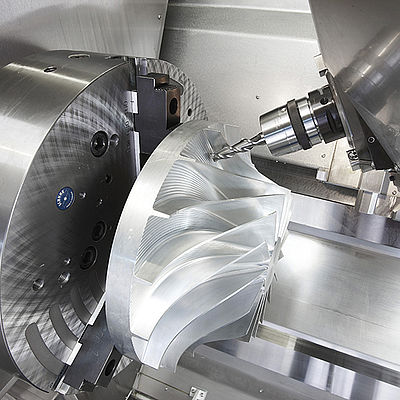
Tool radius compensation
In the five-axis NC program, the tool length compensation function is still effective, but the tool radius compensation function is invalid. When cylindrical milling cutter is used for contact form milling, different programs need to be programmed for different diameters. The current popular CNC system can not complete the tool radius compensation due to insufficient data in the ISO file. After frequent tool change or tool size adjustment during machining, the tool path must be sent back to the CAM system for recalculation, resulting in low machining efficiency.
Norwegian researchers are developing LCOPS (Low Consumption Optimal Production Strategy) as a temporary solution to this problem. The solution transmits the tool path correction data to the CAM system through the CNC application, and sends the calculated tool path directly to the controller. LCOPS relies on third-party CAM software that connects directly to the CNC machine to transfer CAM system files instead of ISO codes. The final solution requires the introduction of a new generation of CNC control systems that can recognize common workpiece model files (such as STEP) or CAD system files.
Post-processor
The key difference between a five-axis machine and a three-axis machine is its two additional rotation coordinates, which result in multiple coordinate transformations of the tool position from the workpiece coordinate system to the machine coordinate system. The popular post-processor generators in the market make it easy to generate post-processors for three-axis machines, but those for five-axis machines are relatively rare and require further development.
In three-axis linkage, the post-processor can automatically handle the relationship between the workpiece coordinate system and the machine coordinate system, without considering the origin position of the workpiece. However, in the five-axis linkage, such as X, Y, Z, B, C five-axis linkage on the horizontal milling machine processing, must consider the position size of the workpiece on the C turntable and the relative position size between the B and C turntables. The processing of these position relationships consumes a lot of time for workers. If the post-processor can process these data, the workpiece installation and tool path processing will be greatly simplified, only need to clamp the workpiece on the workbench, measure the position and direction of the workpiece coordinate system, and enter these data into the post-processor for post-processing, you can get a suitable NC program.
Nonlinear error and singularity problems
The kinematics of five-axis CNC machine tools is more complicated than that of three-axis machine tools because of the addition of rotation coordinates. The first problem caused by rotation is nonlinear error, which is a programming error and can be controlled by reducing the step distance. In the pre-calculation, the programmer cannot predict the magnitude of the nonlinear error, which can only be calculated after the machine tool program is generated by the post-processor. Tool path linearization solves this problem and is usually done in a post-processor.
In addition, the axis of rotation can cause singularity problems. If the singularity is located at the limit position of the rotation axis, even small oscillations nearby may cause the rotation axis to flip 180°, which is a great risk.
Requirements for CAD/ CAM systems
For the operation of pentahedral machining, the user must rely on a mature CAD/CAM system, and must have experienced programmers to operate the CAD/CAM system.
More information please do not hesitate to follow me, and if you are looking for a good cnc machining manufacturer, wellcome to cooperate with us, Yi Tai is a best choice for your sure!
Powder Coating VS Paint
5 Axis Machining - Something you may looking for (Part 2)
Related Article

Choosing between 316 and 316L? 316L resists weld decay better, 316 holds strength at higher heat. Both food-grade, both marine-grade. Quick, no-fluff breakdown.
316 vs 316L Stainless Steel for CNC Machining
What is stamping and when do you use it? A plain guide to sheet metal stamping, dies, and progressive tools, plus the parts it makes faster than machining.
What Is Stamping in Metal Manufacturing?

