
Four Profile steels
author: YITECH
2024-11-23
1045 steel is a medium-carbon steel with a carbon content of 0.45%. It is a widely used steel grade due to its good combination of strength, toughness, and wear resistance. 1045 steel is commonly used in machinery manufacturing, automotive parts, shafts, axles, gears, and many other applications that require good mechanical properties. Its high tensile strength and hardness make it suitable for induction hardening and heat treatment...
Channel steel

Channel steel is a type of carbon structural steel used in construction, machinery, and vehicle manufacturing due to its unique C-shaped cross-section. The section shape of channel steel is concave and is considered a complex cross-sectional steel. It is commonly used for building structures, curtain walls, mechanical equipment, and vehicle manufacturing. China imports more channel steel than it exports and is produced by several steel mills, including Tang Steel, Baosteel, Shandong Steel, Huangte, Magang, Xuan Steel, and Risteel.
Channel steel is required to have good welding, riveting performance, and comprehensive mechanical properties. The raw material for channel steel production is carbon structural steel or low-alloy steel billets with a carbon content of no more than 0.25%. Finished channel steels are delivered in the hot-worked and heat-treated condition. The specifications of channel steel are represented by the height of the waist (h) * the leg width (b) * the waist thickness (d) in millimeters, such as 100 * 48 * 5.3, which represents channel steel with a waist height of 100mm, leg width of 48mm, and waist thickness of 5.3mm, also known as 10# channel steel. If the channel steel has the same waist height but different leg width and waist thickness, it is differentiated with abc added to the model number, such as 25#a25#b25#c, and so on.
Channel steel is divided into ordinary channel steel and light channel steel. The specifications of hot-rolled ordinary channel steel are 5-40# and 6.5-30# for hot-rolled alternative channel steel supplied by agreement between the parties. Channel steel is mainly used for building structures, vehicle manufacturing, other industrial structures, and fixed cabinet racks. It is often used in combination with I-beams. According to the theory of steel structure, the flange of channel steel should bear the load, meaning that the channel steel should be standing upright rather than lying flat.

Channel steel is required to have good welding, riveting performance, and comprehensive mechanical properties. The raw material for channel steel production is carbon structural steel or low-alloy steel billets with a carbon content of no more than 0.25%. Finished channel steels are delivered in the hot-worked and heat-treated condition. The specifications of channel steel are represented by the height of the waist (h) * the leg width (b) * the waist thickness (d) in millimeters, such as 100 * 48 * 5.3, which represents channel steel with a waist height of 100mm, leg width of 48mm, and waist thickness of 5.3mm, also known as 10# channel steel. If the channel steel has the same waist height but different leg width and waist thickness, it is differentiated with abc added to the model number, such as 25#a25#b25#c, and so on.
Channel steel is divided into ordinary channel steel and light channel steel. The specifications of hot-rolled ordinary channel steel are 5-40# and 6.5-30# for hot-rolled alternative channel steel supplied by agreement between the parties. Channel steel is mainly used for building structures, vehicle manufacturing, other industrial structures, and fixed cabinet racks. It is often used in combination with I-beams. According to the theory of steel structure, the flange of channel steel should bear the load, meaning that the channel steel should be standing upright rather than lying flat.

H-beam
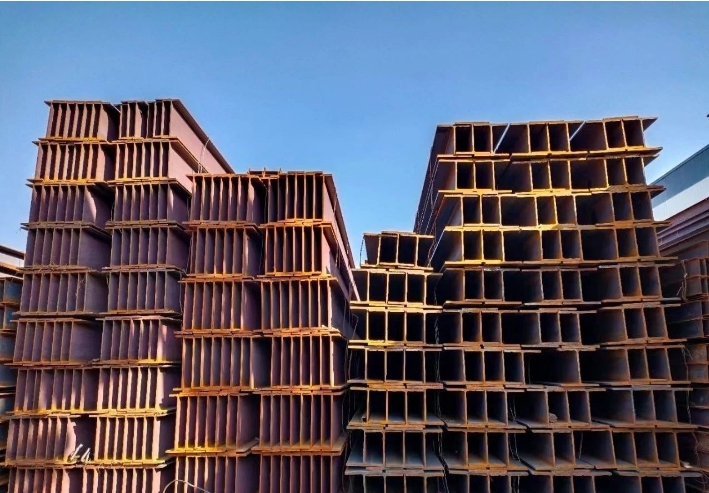
H-beam is an efficient section steel with a more optimized cross-sectional area distribution and a more reasonable strength-to-weight ratio. Due to the H-shaped cross-section design, H-beam has strong bending resistance, easy construction, cost-effectiveness, and light structural weight advantages, making it widely used. The flanges of H-beams are parallel or close to parallel, and the end of the flange is perpendicular, giving it the name parallel flange I-beam. The thickness of the web of H-beams is smaller than that of ordinary I-beams of the same height, while the width of the flange is wider, giving it the name wide flange I-beam. The shape determines that the section modulus, moment of inertia, and corresponding strength of H-beams are significantly superior to ordinary I-beams of the same weight. H-beams are used in various metal structures with different requirements, and their superior performance in bearing bending moments, pressure loads, and eccentric loads can significantly increase the bearing capacity of structures while saving 10% to 40% of metal. The wide flanges of H-beams with thin webs, flexible specifications, and parallel flanges enable saving 15% to 20% of metals in various truss structures. Since the flanges of H-beams are parallel, with the end of the flange at a right angle, they are easy to assemble into various components, thereby reducing welding and riveting work by about 25% and greatly accelerating the construction speed and shortening the construction period.

Here's a trivia question for you: How do you distinguish between 工-beams and H-beams?
Do You Really Know the Five Major Characteristics of Industrial Aluminum Profiles?
Four Types of Profiles
Related Article

Choosing between 316 and 316L? 316L resists weld decay better, 316 holds strength at higher heat. Both food-grade, both marine-grade. Quick, no-fluff breakdown.
316 vs 316L Stainless Steel for CNC Machining
What is stamping and when do you use it? A plain guide to sheet metal stamping, dies, and progressive tools, plus the parts it makes faster than machining.
What Is Stamping in Metal Manufacturing?

