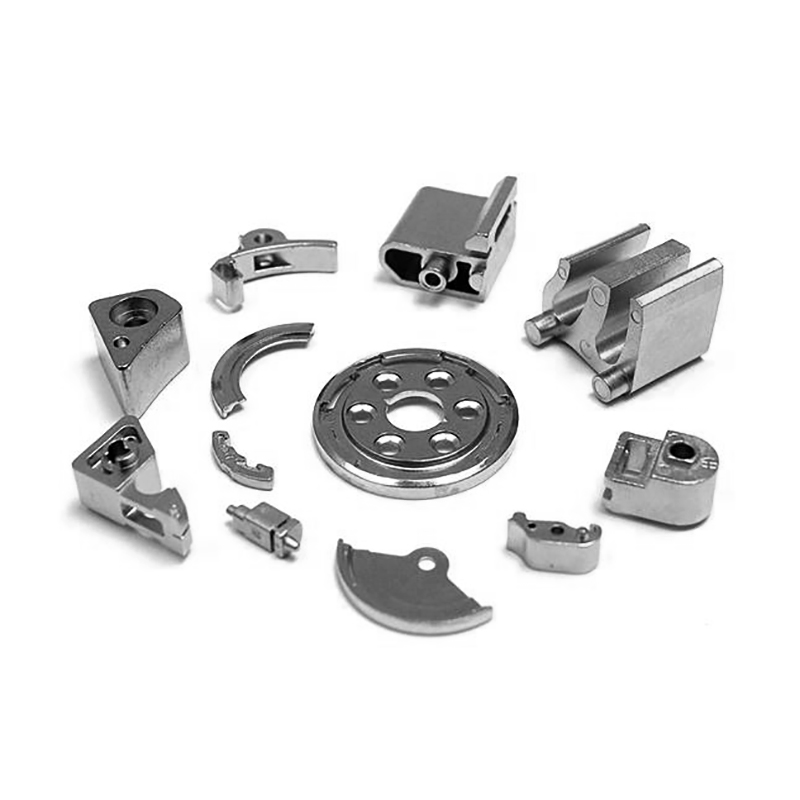
Information of Cold Heading

Cold heading is a manufacturing process used in the production of highly precise metal parts, such as bolts and screws, by shaping raw metal material at room temperature without the need for heating. We are specialized in this process, any needs welcome to contact us!
Cold heading (extrusion) belongs to the category of metal pressure processing, is one of the non-cutting metal pressure processing technology. In production, at normal temperature, an external force is applied to the metal to form the metal in a predetermined mold, which is usually called cold heading (extrusion).
It is usually softened by heat before metal processing, which makes metal processing easier and can improve the mechanical properties of parts. The method of direct processing without heating in the figure above is the cold heading process.
In the fastener forming process, cold heading (extrusion) technology is a main processing technology, cold heading process, the most suitable for the production of bolts, screws, nuts and rivets.
01 What is cold heading?
Cold heading (extrusion) is an important part of precision plastic volumetric forming technology. Cold extrusion means that the metal blank is put into the mold cavity in a cold state, and under the action of strong pressure and a certain speed, the metal material is forced to produce plastic flow, so as to obtain the required shape, size and extrusion parts with certain mechanical properties.
Obviously, cold extrusion processing relies on the mold to control the flow of metal, and relies on the large transfer of metal volume to form parts.
In fact, the forming of any fastener is not only a deformation method of cold heading can be achieved, it in the cold heading process, in addition to the upsetting deformation, but also accompanied by a variety of deformation methods such as positive and reverse extrusion, composite extrusion, punching and rolling.
Therefore, the name of cold heading in production is just a customary name, more precisely, it should be called cold heading (extrusion).
02 Advantages of cold heading (extrusion) process
- Cold extrusion technology is a kind of advanced production technology with high precision, high efficiency, high quality and low consumption, which is widely used in the large-scale production of small and medium-sized forgings. Cold extrusion has the following advantages over other processing processes.
- High utilization rate of steel. Cold heading (extrusion) is a less, no cutting processing method, such as processing rods hex head bolts, cylindrical head hex head screws, using cutting processing method, steel utilization rate is only 25% ~ 35%, and with cold heading (extrusion) method, its utilization rate can be as high as 85% ~ 95%, only the head, the tail and some process consumption of the hexagonal head side.
- Good mechanical properties. Parts processed by the cold heading (extrusion) method, because the metal fiber is not cut, the strength is much superior to that of the cutting process.
- Suitable for automated production. Fasteners suitable for cold heading (extrusion) production (also includes some special-shaped parts), basically symmetrical parts, suitable for high-speed automatic cold heading machine production, is also the main method of mass production.
- Save raw materials. Cold extrusion is the use of metal plastic deformation to make the desired shape of the part, which can greatly reduce the cutting process, improve the utilization of materials. The material utilization rate of cold extrusion can generally reach more than 80%.
- Increase labor productivity. Using cold extrusion process instead of cutting manufacturing parts can increase productivity several times, dozens of times, or even hundreds of times.
- Parts can obtain the desired surface roughness and dimensional accuracy. The accuracy of the parts can reach IT7 ~ IT8, and the surface roughness can reach R0.2 ~ R0.6. Therefore, parts machined with cold extrusion are generally rarely cut again, and only need to be polished at particularly high requirements.
- Improve the mechanical properties of parts. The cold work hardening of the metal after cold extrusion, as well as the formation of a reasonable fiber flow line distribution inside the part, makes the strength of the part much higher than the strength of the raw material. In addition, reasonable cold extrusion process can form compressive stress on the surface of parts and improve the fatigue strength. Therefore, some parts that need to be strengthened by heat treatment can be eliminated by cold extrusion process, and some parts that need to be made of high-strength steel can be replaced by lower-strength steel after cold extrusion process.
- It can process parts with complex shapes that are difficult to cut. Such as special-shaped cross section, complex inner cavity, inner teeth and invisible inner groove on the surface.
- Reduce part costs. Because the cold extrusion process has the advantages of saving raw materials, improving productivity, reducing the cutting amount of parts, and using poor materials instead of high-quality materials, the cost of parts is greatly reduced.
In short, the cold heading (extrusion) method for processing fasteners and special-shaped parts is a processing method with high comprehensive economic benefits, which is widely used in the fastener industry, and is also an advanced processing method widely used at home and abroad and has been developed.

03The difficulties in the application of cold extrusion technology
1) High requirements for molds. When cold extrusion, the blank is subjected to three-directional compressive stress in the mold and the deformation resistance is significantly increased, which makes the stress of the mold far larger than the general stamping die. When cold extrusion steel, the stress of the mold often reaches 2000 ~ 2500MPa. In addition to high strength, the mold needs to have sufficient impact toughness and wear resistance. In addition, the strong plastic deformation of the metal blank in the mold will increase the mold temperature to about 250°C ~ 300°C, so the mold material needs a certain degree of tempering stability. Because of the above, the life of the cold extrusion die is much lower than that of the stamping die.
2) A large tonnage press is required. Due to the large deformation resistance of the blank during cold extrusion, hundreds or even thousands of tons of presses are needed.
3) Due to the high cost of cold extrusion molds, it is generally only suitable for mass-produced parts. It is suitable for the minimum batch is 50,000 to 100,000 pieces.
4) The blank should be surface treated before extrusion. This not only increases the process, needs to occupy a larger production area, and is difficult to achieve production automation.
5) It should not be used for high-strength material processing.
6) The plasticity and impact toughness of cold extrusion parts become worse, and the residual stress of parts is large, which will cause the deformation of parts and the reduction of corrosion resistance (resulting in stress corrosion).
Do you know what is Profile?
Flange basic introduction-phase 12
Related Article